




Refractory Linings in Aluminium Furnaces: Wear, Relining and Dry-Out
The refractory decides how much metal an aluminium furnace really holds, how clean the melt stays and how much energy leaks through the shell. Most lining failures start small – at the metal line, on the ramp or at a cleaning door.
What Is a Furnace Refractory Lining?
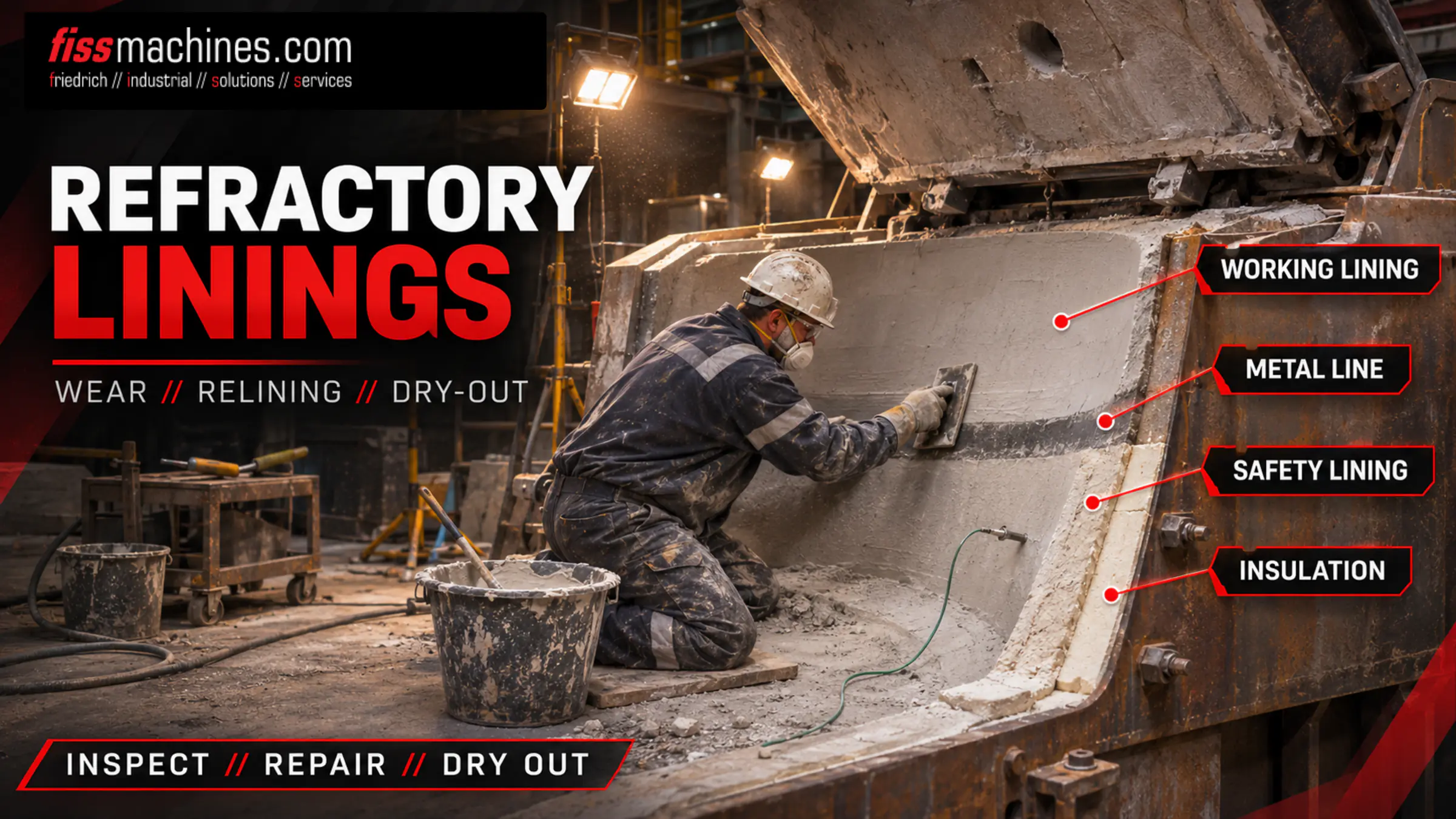
A furnace refractory lining is the multi-layer, heat-resistant structure between the molten metal or hot furnace atmosphere and the steel shell. In aluminium melting, holding and dosing furnaces it has to resist wetting and chemical attack by the melt, mechanical impact from charging and cleaning, and repeated temperature changes, while insulating the shell.
Its condition determines usable bath volume, melt cleanliness, heat losses and the risk of a metal run-out.
How Is the Lining of an Aluminium Furnace Built Up?
Whether reverberatory melter, tower melter, crucible, holding or dosing furnace – the lining of an aluminium furnace usually consists of several layers with different jobs. The furnace manufacturer’s lining drawing is the reference.
Working Lining
In direct contact with melt, dross and atmosphere. Must be dense, aluminium-resistant and tough.
Safety Lining
Dense layer behind the working lining. Stops metal that has penetrated cracks or joints before it reaches the insulation or the shell.
Insulation
Insulating boards, bricks or lightweight castables next to the shell. Keep heat losses and shell temperature low; they lose their effect when soaked with metal.
How melting, holding and dosing furnaces differ in function is explained in Dosing Furnace, Melting Furnace or Holding Furnace?
Which Refractory Materials Are Used for Aluminium Contact?
Most aluminium furnaces are lined with monolithic materials today. For the metal-contact zone, suppliers offer castables with non-wetting additives such as barium sulphate or fluorides and with reduced free silica. Foseco describes its cement-free TRIAD AL castable as resistant to aluminium wetting and penetration for bath, lower sidewall, ramp and sill (manufacturer statement).
| Material | Typical Use | Strengths | Limitations |
|---|---|---|---|
| Cement-bonded castables (incl. low-cement) | Bath, walls, ramps, single-pour linings | Joint-free lining, flexible geometry | Contain water: long cure and controlled dry-out needed |
| Non-wetting aluminium-resistant castables | Metal line, hearth, lower sidewall | Less wetting, penetration and corundum growth | Additive effect can drop if overheated |
| Phosphate-bonded plastics and ramming mixes | Bellyband and spot repairs | Bond to existing lining, low free silica | Installation skill decides the result |
| Pre-cast shapes | Dosing and holding furnaces, launders, tubes | Fired before installation, short downtime | Joints must be designed and sealed carefully |
Additives have limits: according to a Foundry Management & Technology study, firing at higher temperatures can make a non-wetting additive lose its effect. Material choice therefore belongs with the refractory supplier.
Why Does a Furnace Lining Wear?
Corundum Growth at the Metal Line
Corundum (aluminium oxide, Al₂O₃) forms when molten aluminium reduces silica and other oxides in the refractory. Corundum growth is worst in the bellyband around the metal line, at doors, burner walls and rear walls, and is promoted by high temperature, oxygen ingress, certain alloying elements and fluoride fluxes. The volume change cracks the lining; build-up reduces bath volume and increases aluminium losses. A recessed thermocouple that reads too low can cause unnoticed overheating.
Metal Infiltration
Molten aluminium penetrates open pores, cracks and joints. Foseco distinguishes external corundum on the surface from internal corundum formed by penetration. Infiltrated metal widens cracks and can reach the safety lining or insulation.
Thermal Shock and Mechanical Damage
Cold or damp charge, open doors and emptying the bath cause thermal shock. Mechanical damage comes from ingot loading, charging over ramps and sills, and above all from aggressive cleaning with bars. Worn refractory can also release particles into the melt – see Aluminium Melt Quality: Degassing, Filtration and Oxides.
Cleaning and Inspection: How to Slow Down Lining Wear
Regular, gentle cleaning is the most effective lining maintenance: thin deposits come off easily, thick ones only with force – taking refractory with them. For its pre-cast dosing furnace linings, Foseco recommends a weekly cleaning interval (manufacturer statement).
- Clean the metal line while deposits are still thin, with tools suited to the furnace and without levering against the lining
- Keep doors closed and seals intact to limit oxygen ingress
- Use fluxes only as specified, especially fluoride-containing salts
- Inspect at every emptying: cracks, spalling, joints, ramp and sill, tap hole
- Record shell temperatures – new hot spots indicate a damaged lining
Shell hot spots are also an energy topic, as explained in Energy Efficiency in Die Casting.
Repair or Complete Refractory Relining?
The decision depends on how deep the damage goes and whether safety lining and insulation are intact. Illustrative example: a holding furnace shows corundum and spalling only at the bellyband, the hearth is sound and the shell temperature unchanged – a typical case for a local repair.
Patch Repair
Spalling or corundum in a limited zone, intact safety lining. Remove to sound refractory, fill with a compatible repair mix.
Partial Relining
Working lining worn in one zone, e.g. metal line, ramp or door area. Replace the zone, keep the rest.
Complete Relining
Metal behind the working lining, soaked insulation, shell hot spots or repeated repairs. Strip back to the shell and rebuild.
Complete relining means longer downtime: Foseco states that conventional sintering of a monolithic dosing furnace lining takes seven days, while its pre-cast lining is installed in two to four days without sintering (manufacturer statement, Foundry Trade Journal 2019).
Dry-Out Schedule: Why the First Heat-Up Decides Lining Life
A freshly installed castable contains physically and chemically bound water. If it is heated too fast, steam pressure builds up inside the lining and can cause steam spalling. Each material therefore has its own dry-out schedule from the supplier with cure time, heating rates and holds. A new lining also releases moisture that can raise hydrogen pick-up in the first melts.
Cure
Observe the supplier’s minimum cure time and temperature; never start dry-out before the material has set hard, and protect it from frost.
Prepare
Remove wooden formwork, keep vents and weep holes open, position thermocouples close to the lining surface.
Heat Up
Follow ramps and holds exactly; avoid flame impingement on the refractory.
Watch the Steam
If heavy steaming occurs, hold or lower the temperature until it subsides, then continue.
Document
Record the actual curve; deviations are important if damage occurs later.
The steps follow the general cautions of a HarbisonWalker International field guideline; in multi-layer linings every layer counts. Pre-cast systems shorten the dry-out, but the supplier’s heat-up instructions still apply.
Used Furnace Inspection: How to Judge the Lining
On a used aluminium melting, holding or dosing furnace, the lining is often the item with the largest uncertainty. A visual check of the empty, cold furnace shows the surface; the condition behind the working lining can only be deduced from records.
- Date and scope of the last relining, materials used, dry-out records
- Furnace emptied and cleaned so walls, hearth and metal line can be seen
- Cracks, spalling, corundum build-up and remaining wall thickness
- Shell temperature history or thermographs from production
- Alloys and fluxes used in the previous operation
- Lining condition before and after transport documented with photos
Transport is a load case of its own: furnaces are emptied and cooled and the lining assessed before lifting. Vibration and shell deformation can crack an aged lining, so budget for an inspection – possibly a repair and new heat-up – after installation. Dismantling and transport planning are covered in Relocating a Die Casting Machine; heating systems are compared in Induction Furnace or Crucible Furnace?
The Lining Is a Wear Part – Treat It That Way
A furnace refractory lining wears through corundum growth, infiltration, thermal shock and cleaning damage. Correct temperatures, closed doors, careful flux use and early cleaning slow the process; documented inspections show when a repair is enough and when relining is due. After relining, the supplier’s dry-out schedule decides whether the new lining reaches its expected life.
Questions About Refractory Linings in Aluminium Furnaces
Where Does Corundum Form in an Aluminium Furnace?
Corundum forms mainly in the bellyband around the metal line, at doors, burner walls and rear walls where oxygen enters or cleaning is difficult. High temperatures and fluoride fluxes accelerate the reaction.
Can Corundum Be Removed Without Damaging the Lining?
Thin layers can usually be removed with moderate effort during regular cleaning. Thick, grown-in corundum is bonded into the refractory, so removing it often tears out lining material as well.
Why Must a New Lining Be Dried Out Slowly?
A castable contains water that turns to steam. If the temperature rises faster than the steam can escape, pressure builds up and can cause spalling. The supplier’s dry-out schedule prevents this.
How Can the Lining of a Used Furnace Be Assessed?
By inspecting the empty, cold furnace for cracks, spalling and build-up, and by reviewing relining dates, materials, shell temperature records and previous alloys. Hidden damage often shows only as hot spots after heat-up.
Used Furnaces for Aluminium Foundries.
FISS lists used melting, holding and dosing furnaces and can help you clarify condition and lining status before purchase. Contact us with your requirements.
Sources
Foundry Management & Technology: Conquering Aluminum Furnace Corundum, 1 July 2019, accessed 19 November 2026.
A. Wynn, J. Coppack, T. Steele: Assessing Monolithic Refractories, Foundry Management & Technology, 13 June 2011, accessed 19 November 2026.
D. Schmeisser (Foseco): Dosing furnace lining with INSURAL pre-cast shapes reduces downtime in foundries, Foundry Trade Journal, July/August 2019, accessed 19 November 2026.
Foseco: Furnace linings for foundries, product page, accessed 19 November 2026.
HarbisonWalker International: HWI Schedule 2 – PLUS Rated Castables and Gunning Castables: Curing and Dryout General Guidelines, 12/2013, accessed 19 November 2026.
Calderys: Reverberatory melting furnace, application page aluminium & non-ferrous, accessed 19 November 2026.
Aluminium Guide: The Benefits of Monolithic Aluminium Melting Furnace Lining, accessed 19 November 2026.
